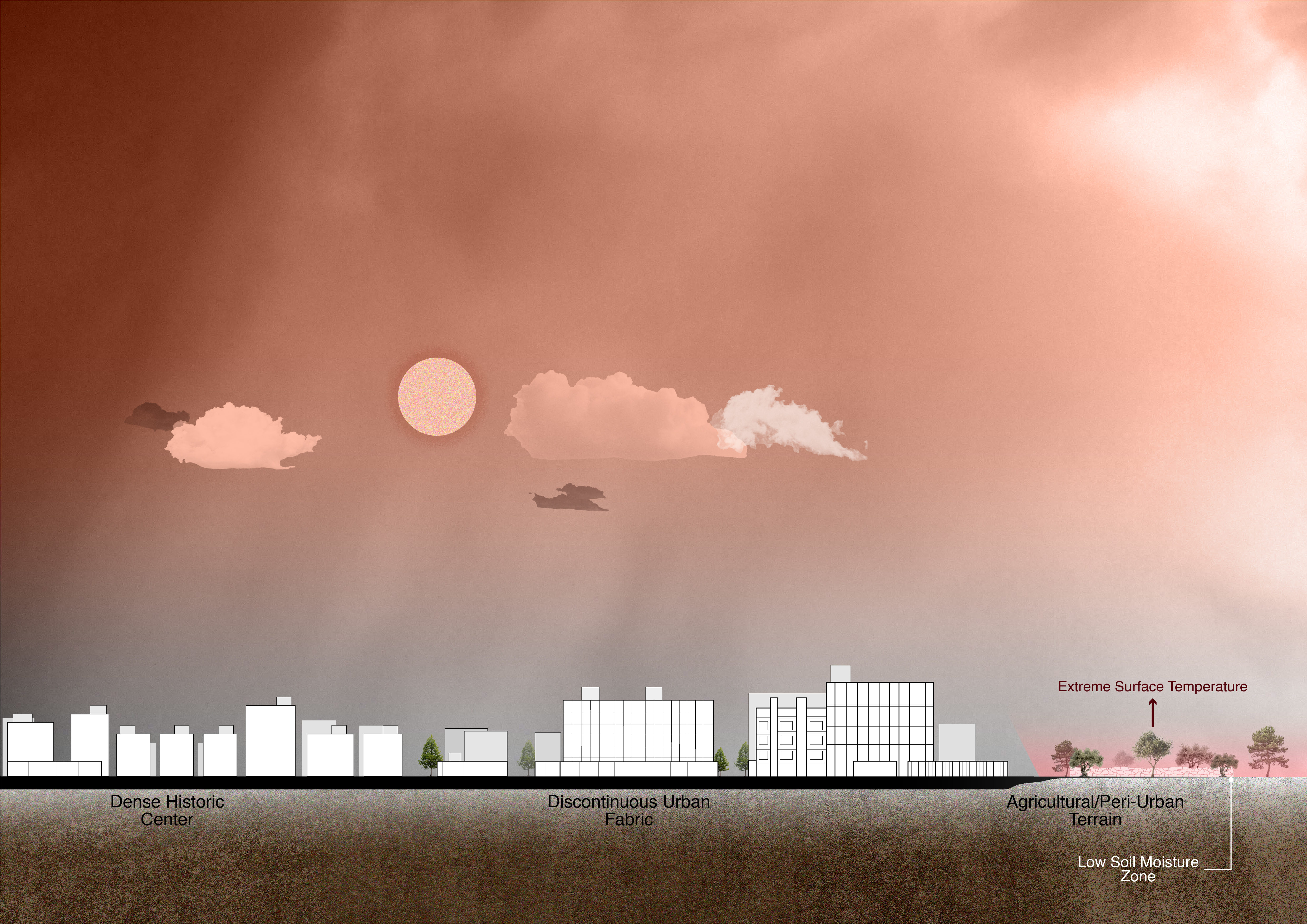
Designing within the Thermal Margin.
Incremental Strategies for Climate Adaptation between Lecce and Salento countryside
Saman Farhadi
Antonio Di Campli
Politecnico di Torino
As recurrent Mediterranean heatwaves redraw the boundaries of city and countryside, the “thermal margin” at Lecce’s peri-urban edge emerges as a laboratory for climatic coexistence. This contribution interprets architectural and urban design as climate adaptation, situated within contexts of infrastructural and social marginality.
Drawing on fieldwork and mapping in the Lecce area, the paper focuses on transitional, often residual spaces where urban stress, soil degradation and agricultural transitions converge, producing heightened environmental and social vulnerability. Here, the thermal margin is not a defensive boundary but a porous interface in which heat, humidity and material flows are metabolized for regenerative purposes, supporting both ecological and domestic economies.
Contrary to capital-heavy, standardized solutions, the approach demonstrates that adaptation emerges from the synergy of unstable karst geomorphology, local materials and minor, repeatable acts of repair. This is operationalized through a Point–Line–Surface toolkit:
Points: small-scale cistern plazas and shade devices for community “coolth”, prompting evaporative and ventilated microclimates;
Lines: restored blue-green corridors (lame) that infiltrate stormwater and function as ventilation paths from countryside to city, reducing flood risk and temperature extremes (Pochodyła et al., 2021; Teofilo et al., 2019; Jiang et al., 2021; Wu et al., 2024);
Surfaces: agri-urban belts with productive, native shade trees (mulberry, fig and drought-hardy pomegranate) that buffer heat and enhance resilience (Schwaab et al., 2021; Dal Borgo et al., 2023; Orlandi et al., 2022; Tarantino et al., 2021).
Each measure is guided by maintenance logic and practical metrics — reduction in surface and air temperatures (ΔT), improved soil infiltration and support for wind corridors — affirming that the spatial translation from defense to coexistence, from boundary to interface, is best achieved through incremental, situated practice.
The thermal margin thus constitutes a paradigm shift for Mediterranean architectural design: an ecology of repair enacted through minor but cumulative transformations, offering grounded lessons for post-climate-crisis transition.